
Why Your Electric Bill is So High (And Why Windows Are the Real Culprit)
Updated: Sep 10
Category: 🪟 Windows | Energy Efficiency
Reading Time: 9 Minutes
It is a scenario every Southern California homeowner knows all too well.
It’s 4:00 PM in mid-August. You get home from work, expecting to step into a cool, refreshing sanctuary. Instead, you are hit with a wall of stagnant heat. You check the thermostat—it’s set to 74°F—but the hallway feels more like 82°F. You can hear your air conditioning unit outside, humming loudly, struggling to keep up. It never seems to cycle off.
Then, the inevitable happens: The monthly utility bill arrives. You open the envelope (or click the email), and the number makes your jaw drop.
Your first instinct is to blame the utility company rates. Your second is to blame your AC unit—maybe it’s too old? Maybe it needs Freon?
But for 90% of homes built in California before 2010, the real thief is silent, transparent, and sitting right in your walls. It’s your windows.
If you are still living with standard "builder-grade" aluminum windows, you are essentially trying to cool a house that has holes in it. In this guide, we are going to break down exactly why your old windows are costing you a fortune, the science behind heat transfer, and how modern vinyl technology can stop the energy bleed once and for all.
The Science of the "Thermal Bridge"
To understand why your bills are high, you have to look at the physics of heat. Heat always moves from hot areas to cold areas. In the summer, the relentless SoCal heat is desperate to get inside your cool home. In the winter, your expensive heated air is trying to escape to the cold outdoors.
Your home’s walls are insulated to stop this. Your roof is insulated. But your old aluminum windows? They are a "Thermal Bridge."
1. The Conduction Problem (The Frying Pan Effect)
Standard windows in California are made of aluminum. Aluminum is a metal. Metal is one of the most efficient conductors of heat on the planet. Think about it: You wouldn’t use a plastic frying pan, right? You use metal because it transfers heat instantly.
When the sun beats down on your aluminum window frames, that metal heats up to over 140°F. Because metal conducts, it transfers that heat directly to the inside of the frame. Your windows effectively become radiators, pumping heat into your living room long after the sun goes down.

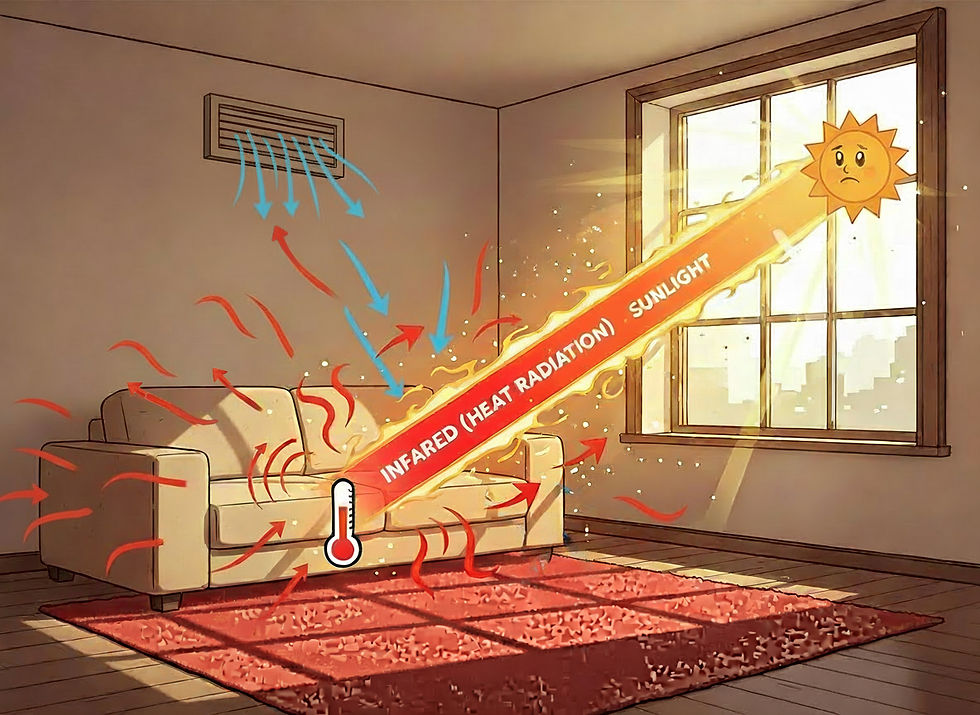
This illustration demonstrates how a standard aluminum window frame, a highly efficient conductor, acts as a direct "thermal bridge," rapidly transferring intense exterior heat inside your home, akin to the heat transfer from a frying pan. This compromising effect makes your home harder to cool and leads to higher energy bills.
2. The Infiltration Problem (The Draft)
If you run your hand along the edge of your old slider windows, you might feel a faint breeze. That is air infiltration. Over time, the "mohair" weatherstripping on aluminum windows wears down. This breaks the seal.
Convection currents force hot, dusty outdoor air through these tiny gaps. It pushes your conditioned air out and replaces it with hot air. Your AC unit isn't just cooling your home; it's trying to cool the neighborhood.

3. The Radiation Problem (The Fishbowl)
Finally, there is the glass itself. Older windows use clear, single-pane glass. This glass offers zero resistance to Infrared (heat) radiation. Sunlight passes right through, strikes your carpet or sofa, and converts into heat. This creates a "greenhouse effect" inside your bedrooms.
The Solution: Why Premium Vinyl Changes Everything
For years, aluminum was the standard because it was cheap and rigid. But in terms of energy performance, it is obsolete. The modern solution is Premium Vinyl.
Unlike metal, vinyl (Polyvinyl Chloride) is a natural insulator. It does not conduct heat. Even when it is 100°F outside, the interior frame of a Hometime vinyl window remains cool to the touch. This breaks the "Thermal Bridge."
But Not All Vinyl Is Created Equal
You may have heard horror stories about vinyl windows turning yellow or warping in the sun. That is true for "recycled" or "blue-label" vinyl found at big-box hardware stores.
At Hometime Windows, we use a proprietary vinyl compound enriched with Titanium Dioxide.
Heat Resistance: Titanium Dioxide acts as a sunscreen for the window. It reflects UV rays, ensuring the frame never yellows, chalks, or becomes brittle.
Structural Integrity: Our frames utilize a multi-chambered "honeycomb" design. These internal air pockets create dead space that adds strength and further insulates your home against noise and temperature.
Not ready for a quote yet? Download our free window checklist and take it with you to every bid you get.
The Secret Weapon: Low-E366 Glass
The frame is half the battle; the glass is the other half. We equip our windows with Low-E366 Glass, the industry standard for high-heat environments.
"Low-E" stands for Low Emissivity. It is a microscopic coating of silver applied to the inside of the glass panes. It acts as a transparent mirror for heat.
Summer Performance: It allows visible light to pass through (so your room stays bright) but reflects the invisible Infrared heat back outside.
Winter Performance: It reflects your furnace’s heat back into the room, keeping you warm.
Fade Protection: The coating blocks 95% of harmful UV rays. This means your expensive hardwood floors, curtains, and photos won't fade or bleach out from sun exposure.
🌟 Social Proof: Homeowner Spotlight
“We had all of our windows and a slider replaced. We noticed an immediate difference in the temperature of our home. It stays so much cooler now! The crew was professional, cleaned up after themselves, and finished ahead of schedule. No stucco damage at all!”— Sarah J., Rancho Cucamonga (Verified Customer)
The ROI: Is It Worth the Investment?
Homeowners often ask, "Will I actually see a return on this investment?" The data says yes.
According to the U.S. Department of Energy and Energy Star reports, replacing single-pane aluminum windows with double-pane vinyl windows in Southern California saves the average homeowner 12% to 15% on annual heating and cooling costs.
For a home with a $400 summer electric bill, that is real cash back in your pocket every single month. Beyond the monthly savings, new windows increase your home’s resale value and curb appeal, offering an average ROI of over 70% at resale.
Common Myth: "Replacing Windows ruins my Stucco"
This is the #1 fear that stops homeowners from upgrading. They imagine a demolition crew breaking their exterior stucco, damaging the drywall, and leaving a mess that requires a painter to fix.
The Hometime Reality: The Retrofit Method
We specialize in a clean, non-invasive installation method known as "Retrofit" or "Flush Fin."
We Do Not Break Stucco: We leave the original aluminum frame embedded in your wall. This is crucial because damaging the old frame can break the waterproof paper barrier behind your wall.
The Flush Fin: We install the new vinyl window over the old frame. A specialized decorative flange (the Flush Fin) covers the old metal, creating a sleek, brand-new look.
One Day Turnaround: Because there is no stucco repair needed, our crews can typically replace 10–15 windows in a single day. You leave for work with old windows and come home to a transformed house.

The "Invisible" Energy Leak: Our 4-Layer Sealing Process
It is a dirty secret in the industry: You can buy the most expensive, energy-efficient window on the planet, but if it is installed poorly, you are throwing your money away.
The "crack" in your window isn't usually the glass—it's the gap between the window frame and your house. Many contractors skip the details here to save time. They slide the window in, put a thin line of cheap caulk on the outside, and call it a day.
At Hometime, we use a proprietary 4-Layer Sealing Process to ensure your home is completely airtight:
The Primary Barrier: Before the window is even set in the opening, we apply a thick, structural bead of high-grade sealant around the entire perimeter of the old frame. The new window is bedded into this seal, stopping water before it can even enter.
The Exterior Shield: Once the window is set, we caulk the outside edge where the flush fin meets your stucco. This is your first line of defense against rain.
The Thermal Core (Spray Foam): From the inside, we fill the cavity between the window and the wall stud with specialized Low-Expansion Window Foam. Unlike standard fiberglass insulation (which air passes right through), this foam expands to fill every nook and cranny without bowing the frame. It locks out heat and drafts permanently.
The Aesthetic Finish: Finally, we install a clean, adhesive vinyl trim (flat trim) on the interior to cover the foam, followed by a final precision bead of caulking.
The result? A complete, lasting seal that looks as good as it performs. No drafts. No ugly gaps. Just lower electric bills.


📊 Data Comparison: Old vs. New
See the difference in the numbers. "U-Factor" measures how well a window insulates (lower is better). "SHGC" measures how much heat it lets in (lower is better).
Performance Metric | Old Aluminum Single-Pane | Hometime Double-Pane Vinyl | The Impact |
U-Factor (Insulation) | 1.20 (Terrible) | 0.28 - 0.29 (Excellent) | Stops heat from escaping/entering. |
SHGC (Heat Block) | 0.80 (Lets 80% heat in) | 0.22 (Blocks 78% of heat) | Drastically reduces AC load. |
UV Block | ~15% | ~95% | Protects furniture from fading. |
Sound Transmission | STC 20-25 | STC 30-34 | Reduces street noise significantly. |
Frequently Asked Questions
Q: How do I tell whether my current windows are actually costing me money?
A: Three checks you can do yourself in about ten minutes, before anyone quotes you anything. First, put your hand flat on the glass of a west-facing window on a hot afternoon. If the glass is hot to the touch, that heat is moving into the room and your air conditioner is paying for it.
Second, count panes. Hold a pen tip against the glass and look at the reflections: two reflections means a single pane, four means dual-pane. Single-pane glass is the single biggest thing you can change in a Southern California house, and plenty of homes built before the mid-1980s still have it.
Third, look for a failed seal — haze, streaking or a film between the panes that will not wipe off from either side. That means the insulating gas has escaped, and that window is performing close to single-pane no matter what it cost when it went in.
(We’ll bring the glass samples to you, so you can feel the heat-blocking difference yourself!)
Do I need stucco repair or repainting after new windows go in?
With a retrofit installation, no. The retrofit method leaves the original window frame and the stucco around it in place, and the new window's flush fin covers the seam, so there is no cut stucco to patch and no exterior repainting. Inside, a vinyl trim wrap covers the old sill and jamb, so there is no bare wood to prime or paint.
The alternative is a new-construction or full-frame install, which takes the opening back to the studs. That means cutting stucco, and it means a stucco contractor and a painter after the window crew leaves. Both methods are legitimate. Retrofit is the right answer for most Southern California homes because the original frame is sound and the stucco is intact.
When you compare bids, ask each company in writing which method they are quoting and whether stucco and paint are included. That one line item is where two quotes that looked similar stop being similar.
Do vinyl windows warp or yellow in the California sun?
Cheap vinyl can. Vinyl formulated for this climate does not, and the difference comes down largely to how much titanium dioxide is in the mix.
Titanium dioxide is the UV stabilizer in vinyl. It is what keeps the sun from breaking the material down and leaving it chalky and brittle. We run 10 parts per hundred in our extrusions, which is at the higher end of what residential vinyl uses. Lower-cost vinyl usually runs less, because TiO2 is one of the more expensive ingredients in the formula.
Frames also tend to fail at the corners rather than in the middle of a span, which is why welded corners matter more than frame thickness. If you are comparing products, ask two questions: how much titanium dioxide is in the vinyl, and are the corners welded or mechanically fastened. A supplier who cannot answer the first one has told you something.
What does the window warranty actually cover?
Hometime's warranty is a Lifetime Warranty covering the vinyl frame, the hardware — locks, rollers and balances — and the glass seal against fogging. It is not transferable. It covers you as the homeowner rather than following the house to the next owner.
Worth knowing when you compare warranties: in most of this market the product warranty is written by the manufacturer and the labor warranty by the installer, so a failed seal and a bad installation are two separate claims against two separate companies. Because we manufacture the windows and install them ourselves, both sit with us. Ask any bidder who holds each half of that.
Can I match the grid pattern on my existing windows?
Yes. Grids are specified opening by opening, so you can match what is on the house now or change it.
The patterns that come up most in Southern California housing stock are colonial grids on ranch and traditional homes, prairie grids — a perimeter border rather than a full grid — on newer and architectural homes, and top-sash-only grids on Craftsman bungalows, where the lower sash is traditionally left clear.
Grids sit between the panes rather than on the glass surface, so there is nothing to dust around. The detail people miss: if you replace some windows now and the rest later, grid spacing has to be specified so the lines align across openings on the same wall. Ask for that to be written on the order.
How do I choose a window installer in Southern California?
Judge on four things you can verify before you sign anything.
License and insurance. Look up the contractor's license number at cslb.ca.gov yourself, and ask for a current certificate of insurance rather than a photo of one.
Who actually installs. Some companies sell the job and subcontract the installation. That is legal and common, but it means the crew in your house has no direct relationship with the company that sold you the windows. Ask directly.
What the quote includes. Openings measured individually, priced individually, with stucco and paint addressed in writing.
How long the price is good for. A price that expires when the salesperson stands up is a tactic, not a price. Ours stay valid for 30 days.
Does Low-E glass really stop furniture and floors from fading?
It substantially reduces fading, but nothing stops it completely, and any company telling you otherwise is overselling.
Ultraviolet light is the main driver, and the Low-E 366 glass we install as standard blocks roughly 95% of it. Fading is also driven by visible light and heat, which the coating reduces but does not eliminate. A rug in a west-facing window will still change over many years, just far more slowly.
The effect homeowners notice sooner is heat. Low-E coatings reflect infrared, so the hot zone a few feet inside a sunny window shrinks and rooms that were unusable at four in the afternoon become usable. That is the change people call us about far more often than fading.
What glass should I ask for if heat and sun are the main problem?
For most Southern California homes, a dual-pane unit with a spectrally selective triple-silver Low-E coating and an argon fill. Low-E 366 is what we install as standard: it turns down solar heat while still passing visible light, so the room stays bright rather than tinted.
Two numbers on the NFRC label tell you whether a window will actually do this. Solar Heat Gain Coefficient is the share of the sun's heat that gets through, and lower is better here — mainstream high-performance packages land in the 0.20s. U-Factor measures how much heat conducts through the whole assembly. Salespeople tend to lead with U-Factor because it sounds technical, but in this climate SHGC is the number that changes how a room feels.
Ask for both, in writing, on the quote. Every window sold in California has them.
Do black window frames make a house hotter?
A black frame absorbs more solar heat than a white one, but the effect on your cooling load is small, because the frame is a small share of the window's area and the glass does the real work.
Two things matter more than the color. First, whether the color is extruded through the vinyl or painted onto a white frame — painted finishes can chalk or peel in this climate, and when they do the white underneath shows. Ours are pigmented through the material. Second, whether the vinyl formula is stabilized for dark colors, since dark frames run hotter and expand more.
If you are considering black, ask whether the warranty treats dark colors differently. Some manufacturers exclude or limit them, and that exclusion is easier to find before you buy than after.
What do energy-efficient windows actually change in a Southern California house?
Mostly comfort. The size of the utility effect depends entirely on the house, and we don't quote a savings percentage, because it turns on what you're replacing, your insulation, your HVAC system, your home's orientation and your utility rate.
What customers describe is fairly consistent: rooms on the west side become usable in the afternoon, the air conditioner cycles less in the evening, and street noise drops. One Corona homeowner measured his old window surface at 159°F on a summer afternoon and 94°F after replacement. That is one house, not a guarantee, but it is the kind of change people notice.
Single-pane to dual-pane is the big jump. Dual-pane to a better dual-pane is a real but smaller one, and it is worth being honest with yourself about which of those you are actually doing.
Where are Hometime's windows made?
In Upland. The factory and showroom share a building on West 9th Street, and the vinyl windows we install are extruded, assembled and glazed there rather than ordered from a national manufacturer and shipped in.
In practice that means custom sizes are not a special-order surcharge, lead times are shorter because there is no distribution chain in the middle, and there is one company to call if something is wrong. It also means the showroom visit and the factory walk-through are the same trip, so you can see how the window is put together before you buy it.


Comments